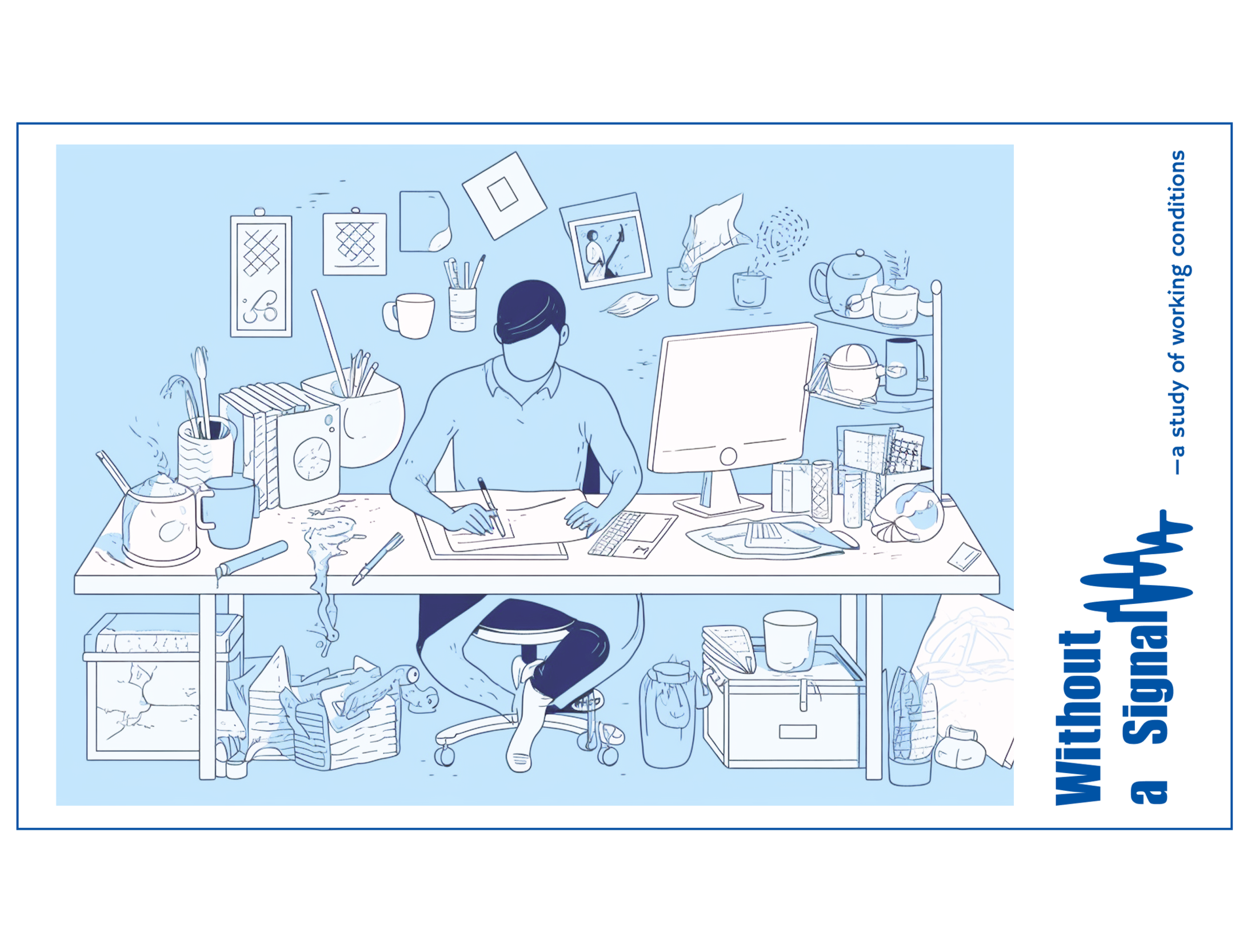
“I’m always in the same place, just not at the same moment.”
— A remote worker describing life without clear boundaries
secondary research
The Burnout Society
Author: Byung-Chul Han
This book describes a shift from external control to self-imposed pressure in modern work culture.
Instead of being forced by authority, individuals push themselves to perform, optimize, and remain productive. This leads to exhaustion and burnout. This dynamic becomes visible, as workers feel the need to demonstrate productivity without direct supervision.
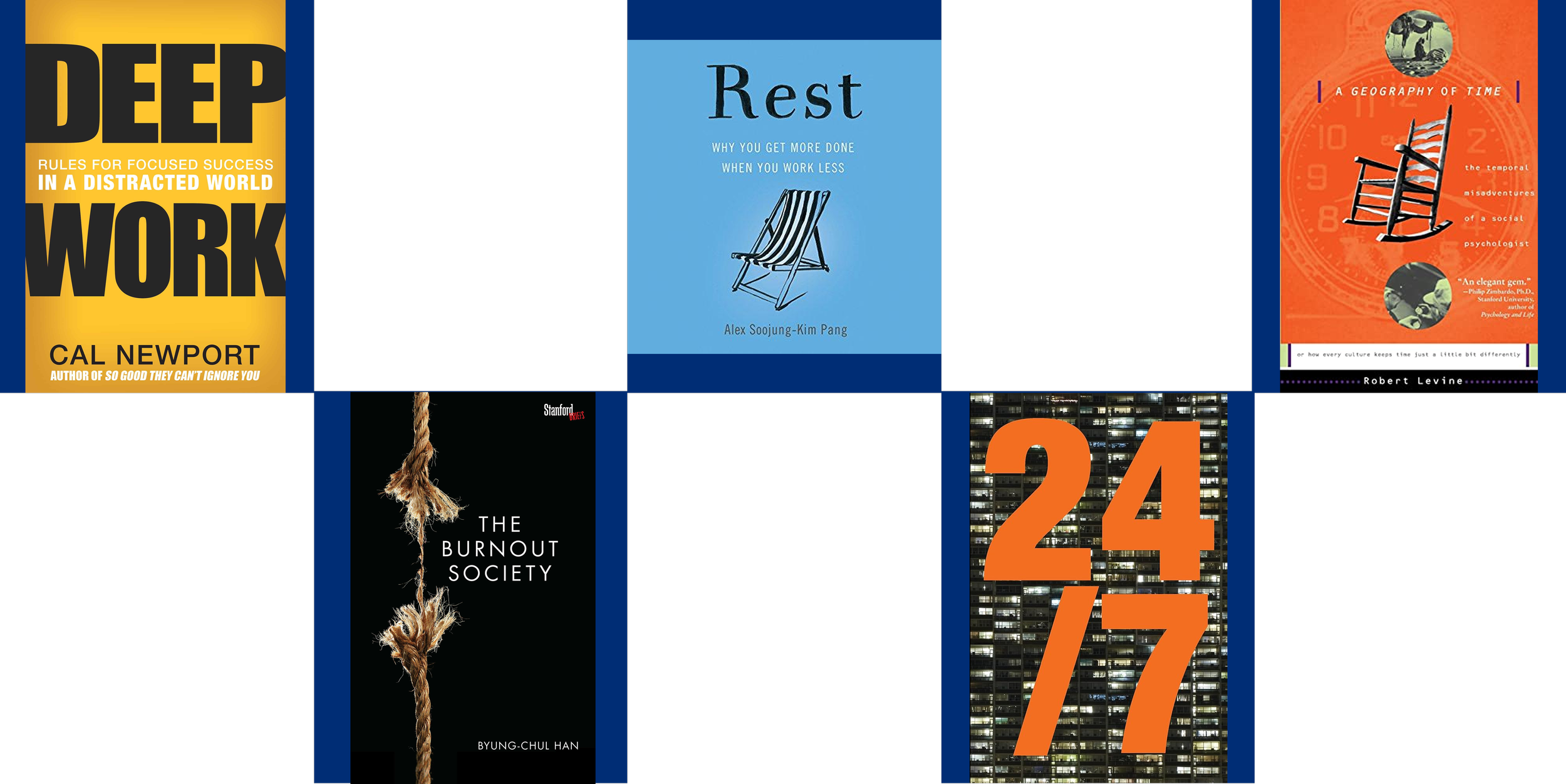
Deep Work
Author: Cal Newport
This book explores the concept of “deep work,” defined as the ability to focus without distraction on cognitively demanding tasks.
Newport argues that modern digital environments fragment attention and reduce the capacity for sustained focus. Frequent interruptions, notifications, and multitasking make it difficult to enter deep, meaningful work states.
Rest: Why You Get More Done When You Work Less
Author: Alex Soojung-Kim Pang
.This book argues that rest is not simply the absence of work, but an essential part of productive and creative processes.
Pang shows that rest requires structure, intention, and clear boundaries in order to be effective.
A Geography of Time
Author: Jonathan Crary
This book explores how different cultures and environments shape people's perception and use of time.
Levine argues that time is not fixed, but constructed through social and environmental conditions.The absence of structured environments leads to a more fluid and ambiguous experience of time, contributing to disrupted rhythms.
24/7: Late Capitalism and the Ends of Sleep
Author: Jonathan Crary
This book examines how contemporary society operates in a continuous, 24/7 cycle, where traditional boundaries between day and night, work and rest, are increasingly blurred.
Crary argues that systems of production and consumption extend into all aspects of life, reducing opportunities for rest and disconnection.
Theoretical Synthesis
01
Across these readings, a consistent pattern emerges:

the structure surrounding work — not just the work itself — has fundamentally shifted.
Attention is increasingly fragmented, as digital environments encourage constant switching between tasks, platforms, and contexts.
Work is no longer contained within focused periods, but distributed across continuous interruptions.
At the same time, time loses its clear boundaries.
Rather than being divided into distinct phases of work and rest, it becomes extended and continuous, making it difficult to identify when work has truly ended.
This condition is reinforced by a shift in labor dynamics.
Without direct supervision, individuals internalize pressure to remain productive, leading to ongoing engagement that is self-imposed rather than externally required.
Rest, in this context, is no longer automatic.
It depends on clear transitions and structural signals, which are often missing in remote work environments.
Together, these perspectives suggest that the challenge of remote work is not simply behavioral, but structural.
It is not about how individuals manage their time, but how time, space, and attention are organized.
SME Interviews

Holly Wang
“Emojis are too loud, and text is too slow. A lot of emotional states live in between.”


Xiaowen Chen
“People’s feelings don’t disappear in remote work — they just have nowhere to go.”

Wendy Lu
“Remote teams don’t lack communication — they lack emotional context. And when that context disappears, people start filling in the gaps themselves.”
Elaine Porter
“Emojis are too loud, and text is too slow. A lot of emotional states live in between.”
Haofeng Zhang
“Productivity is visible. Morale is invisible. And that’s where most of the risk lives.”
Marcus Porter
“Remote work doesn’t fail because of distance. It fails because interpretation becomes fragile.”
Across interviews, boundaries are not described as fixed limits, but as something defined by signals.

Participants pointed out that in remote work, many of the signals that indicate the start or end of work are weakened or absent.

Without these cues, it becomes difficult to determine when a situation shifts from work to non-work.

In physical environments, boundaries are often collectively understood.

However, in remote settings, participants described that these boundaries are no longer shared.

Actions such as sending a message late, or continuing a conversation outside work hours, are interpreted differently by different people.

This leads to inconsistent expectations around when work applies.

Participants noted that boundaries are no longer directly visible,
but must be interpreted.

Simple actions — such as a delayed reply or a short message — can be read as either disengagement or ongoing work.

Because there is no clear reference point, individuals rely on personal judgment to define boundaries.

Another recurring observation is that visibility does not clearly indicate boundaries.

While outputs and activities can be tracked, they do not reveal whether someone is still working, pausing, or transitioning.

As a result, boundaries cannot be inferred from what is visible alone.

Together, these insights suggest that the breakdown of boundaries in remote work is caused by the absence of clear and shared signals.

Boundaries are no longer defined externally, but constructed through individual interpretation.

This shifts the responsibility of defining boundaries from the environment to the individual.
Theoretical Synthesis
02
Problem Framing

-
Remote work is often framed as a question of productivity — whether people are more or less efficient outside the office.
However, a growing body of research suggests that the more significant impact lies not in output, but in how work is structured and experienced.According to a 2023 report by Gallup, over 70% of remote-capable employees in the U.S. now work in hybrid or fully remote settings.
At the same time, employees report higher levels of stress, difficulty disengaging from work, and challenges in maintaining clear work-life boundaries.Similarly, Microsoft’s 2022 Work Trend Index found that 87% of employees believe they are productive,
while 85% of leaders struggle to trust that productivity — revealing a disconnect not of performance, but of visibility and structure.This suggests that the issue is not simply whether work is being done,
but how work is perceived, managed, and bounded. -
In traditional work environments, boundaries were not only physical but procedural.
The office, the commute, and the workday schedule acted as implicit signals — defining when work began and when it ended.Sociologist Erving Goffman described everyday life as a performance structured by context —
where different settings allow individuals to shift roles, behaviors, and expectations.Remote work disrupts this structure.
Without spatial and temporal separation, individuals must continuously negotiate their role:
Are they working, resting, or somewhere in between?This constant negotiation transforms what was once a passive transition into an active cognitive task.
-
Research on digital labor and remote work has increasingly pointed to the phenomenon of “always-on” culture.
Employees remain reachable across platforms — Slack, email, messaging — often beyond formal working hours.A study published in the Harvard Business Review highlights that remote workers tend to extend their working hours,
not necessarily through focused work, but through fragmented, intermittent engagement throughout the day.Rather than clear periods of work and rest,
time becomes dispersed into micro-interactions.This creates a condition where individuals are rarely fully disengaged,
but also rarely fully focused. -
Another critical dimension is emotional visibility.
In physical workplaces, subtle cues — posture, presence, tone — allow people to perceive others’ states.
In remote settings, these signals are reduced, optional, or intentionally hidden.In my own research, many participants chose to remain camera-off during meetings.
This was not simply a matter of comfort, but a strategy of control —
a way to manage how much of themselves is visible to others.As a result, emotional states are still present,
but become less legible to others.This creates a gap between experience and perception —
where people feel, but are not seen. -
Taken together, these patterns point to a systemic issue.
Remote work environments lack clear signals for:
• when to begin
• when to pause
• when to stop
• how to be present without overexposing oneselfAs a result, individuals are left to construct these boundaries on their own.
What is often interpreted as poor discipline, distraction, or lack of motivation
is, in fact, a response to missing structure.This shifts the question:
The problem is not how to make people work better.
It is how to design environments that support working — and stopping.This thesis approaches remote work not as a behavioral problem,
but as a design problem.